The most fun way to learn pitch accent and break the 漢字 wall.
I love learning from songs, but pasting lyrics into three different apps just to understand one sentence killed the vibe.
So I built a simple, offline tool that does it all in one place. Paste your lyrics, see the pitch accents instantly, and finally understand Kanji without pausing the music.
Get for iOS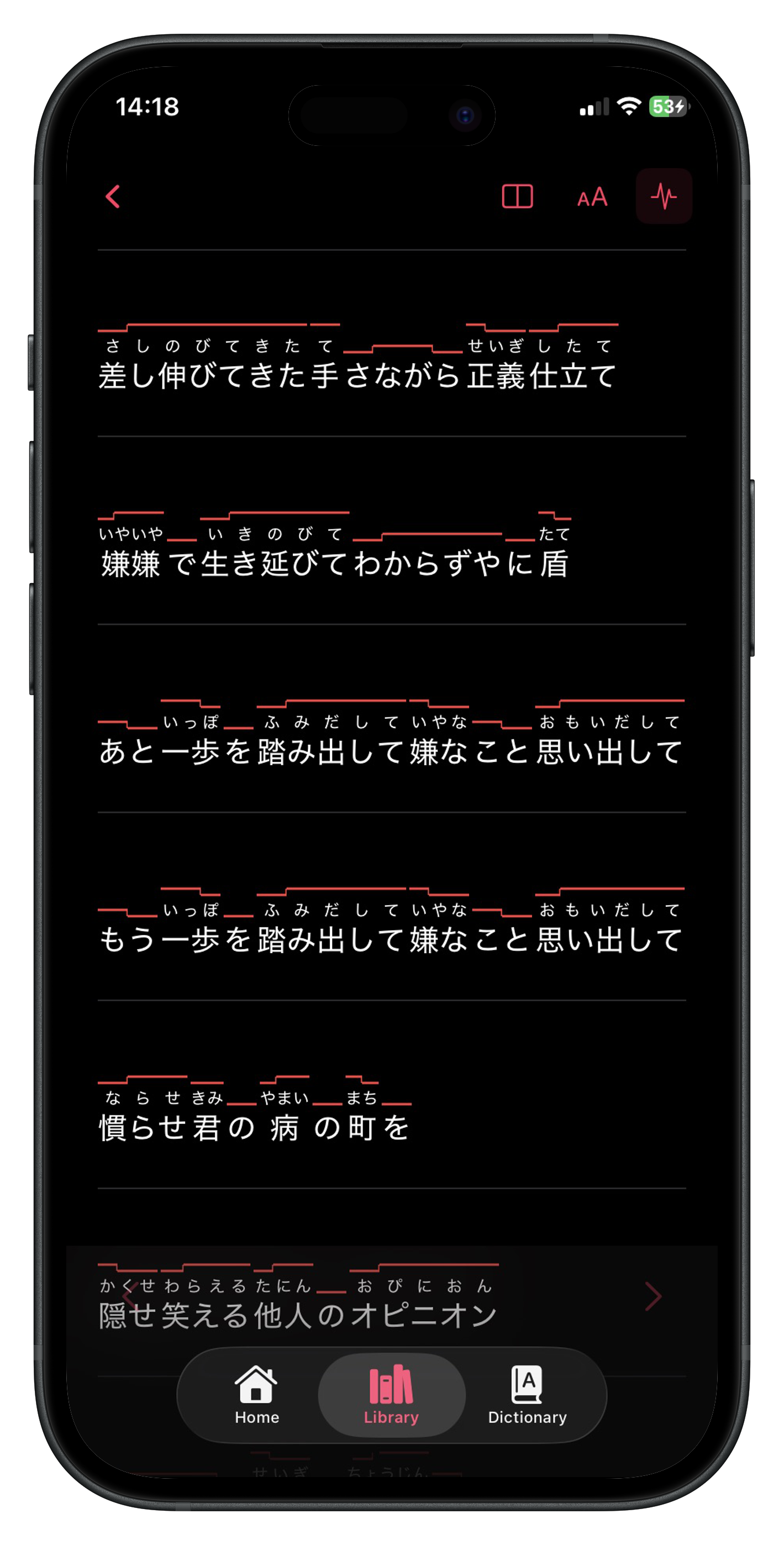
How It Works
Pick a song you actually like
Forget the textbook dialogues. Copy the Japanese lyrics from that track you've had on repeat for weeks.
Paste them in
Drop the text into the app. It instantly maps the English translation and highlights the pitch accents for you.
Tap what confuses you
Don't know a character? Just tap it. The app breaks the Kanji down into its parts (radicals) so you can see the logic behind the scribbles.
Sing along
Enjoy your music knowing what you're ACTUALLY singing about.
Why I Built This
Kanji that actually sticks
I hated rote memorization. It doesn't work. This tool breaks complex characters down into 'radicals'—the little building blocks—so you can turn strokes into a story you'll actually remember.
Pitch accent you can see
Most resources ignore pitch accent, which is why so many of us struggle to sound natural. I built a visualizer that layers the pitch drops right over the lyrics, so you know exactly how to say it.
No loading screens
I wanted to study on the subway, so I made the whole thing work offline. The database lives on your phone. It's instant, snappy, and doesn't need a signal.
The "One-Screen" Flow
Stop switching between Spotify, Jisho, and Anki. I wanted to see the meaning, the reading, and the breakdown without losing my place in the song. Now you can too.
FAQ
From the Blog

Yuki (雪) Shows Up in Almost Every Japanese Winter Song. The Kanji Itself Is Rain Falling From a Pig's Snout.
雪 means snow, but the kanji is built from 雨 (rain) sitting on top of an old snout radical. Once you see it, J-pop winter songs that use 雪 stop sounding like weather.

Haru (春) Shows Up in Almost Every J-Pop Song You Love. The Kanji Itself Is the Sun Catching a Plant the Moment It Pushes Through the Ground.
春 means spring. The kanji breaks into sun above a sprouting plant. Once you see it, J-pop songs about spring stop being about cherry blossoms.
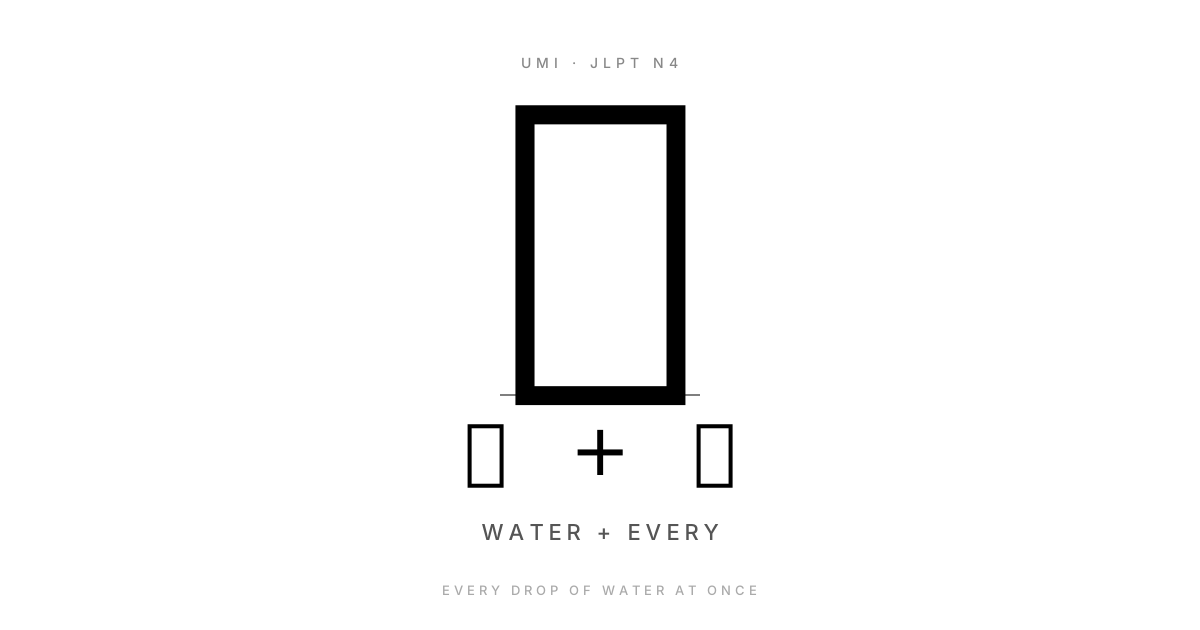
Umi (海) Shows Up in Almost Every J-Pop Song You Love. The Kanji Itself Means Every Drop of Water at Once.
海 means sea. The kanji breaks into water plus every: every drop of water. Once you see it, J-pop songs about the sea stop being about the beach.
Ready to learn Japanese the fun way?
Now available on App Store.
Get for iOS